Using a blank guitar fretboard diagram PDF
Learning the guitar can feel like trying to navigate a city without a map. You know the music is in there somewhere, but finding the right “streets” (or notes) in the heat of a solo can be daunting. The bridge between being a beginner and a fluent player lies in two powerful concepts: Muscle Memory and the Visual Advantage.
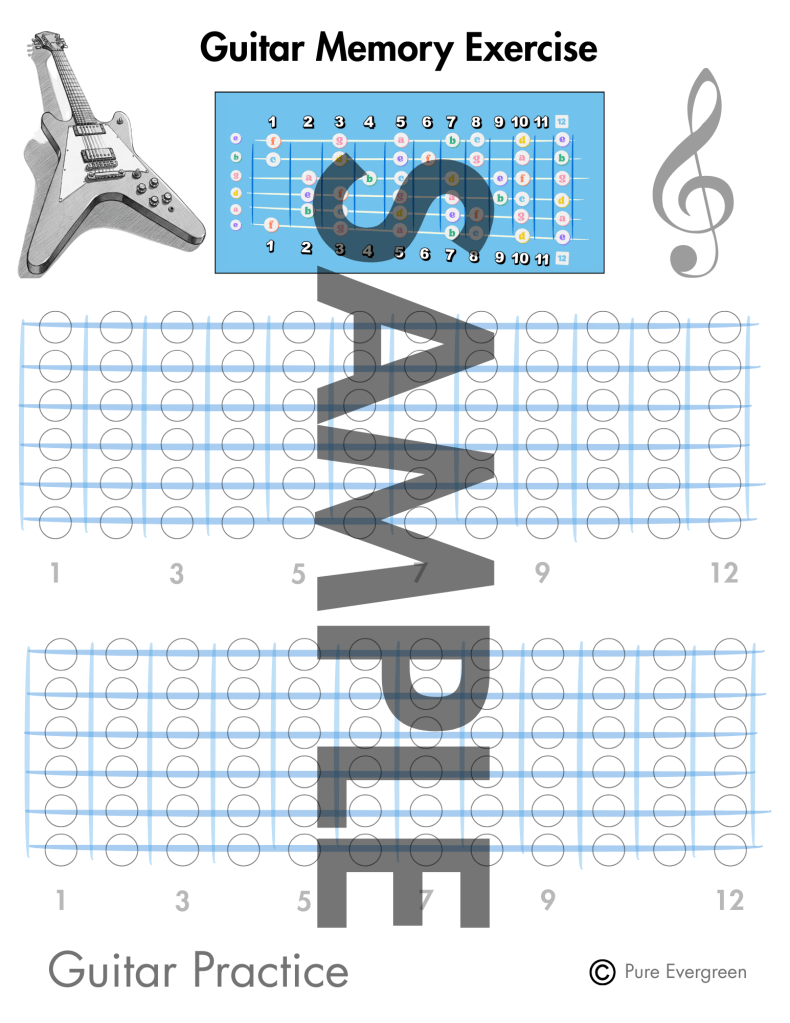
To master these, your greatest tool isn’t a complex book of theory—it’s a blank guitar fretboard diagram PDF. Here’s why.
1. The Power of Muscle Memory
Muscle memory is the brain’s ability to perform a task without conscious effort. On guitar, this means your fingers “knowing” where to go before your brain even processes the note name.
When you practice scales like the A Minor Pentatonic, you are training your nervous system. By repeating a physical movement over and over, you create a neural pathway. Eventually, you stop thinking “Middle finger, 5th fret” and start thinking “A,” and your hand simply reacts.
Pro Tip: Slow is smooth, and smooth is fast. Muscle memory is built through perfect repetition, not fast repetition. Use a metronome and focus on clean, natural notes.
2. The Visual Advantage: Mapping the Fretboard
The guitar is a highly geometric instrument. Unlike a piano, where notes move in a straight line, guitar notes move in “shapes” and “intervals.” This is where the visual advantage comes in.
By using a blank guitar fretboard diagram, you stop being a passive listener and start being an active cartographer. When you physically draw the natural notes (A, B, C, D, E, F, G) onto a paper diagram, you begin to see patterns:
- The diagonal “octave shapes.”
- The “half-step” clusters where B/C and E/F sit right next to each other.
- The repeating “box shapes” of your favorite scales.
3. Why a Blank Fretboard PDF is Your Best Teacher
Why use a blank diagram instead of one already filled out? Because encoding information is a key part of learning.
- Active Recall: When you have to remember where the “C” is on the G-string and draw it yourself, your brain works harder than if you were just reading a guitar notes chart.
- Customization: You can create your own “maps.” Use one sheet for natural notes, another for the pentatonic scale, and a third for your “target notes” in a specific song.
- Tactile Learning: The physical act of writing reinforces the visual image, which in turn speeds up your muscle memory.
How to Start Your Visual Practice
- Download a blank guitar fretboard notes PDF. 2. Pick one note: Start with all the “A” notes on the neck. Find them and mark them on your diagram.
- Connect the dots: Visualize the shape those dots make. Is it a triangle? A diagonal line?
- Transfer to the instrument: Play those notes while looking at your hand, then play them with your eyes closed to test your muscle memory.
By combining the physical “feel” of the strings with a clear visual map, you’ll find that the fretboard stops being a mystery and starts being a playground.
 Coffee & a Playlist
Leave a comment